

New Peer-Reviewed Research Shows That Tissue Preservation Significantly Impacts the Future Utility of Precision Oncology
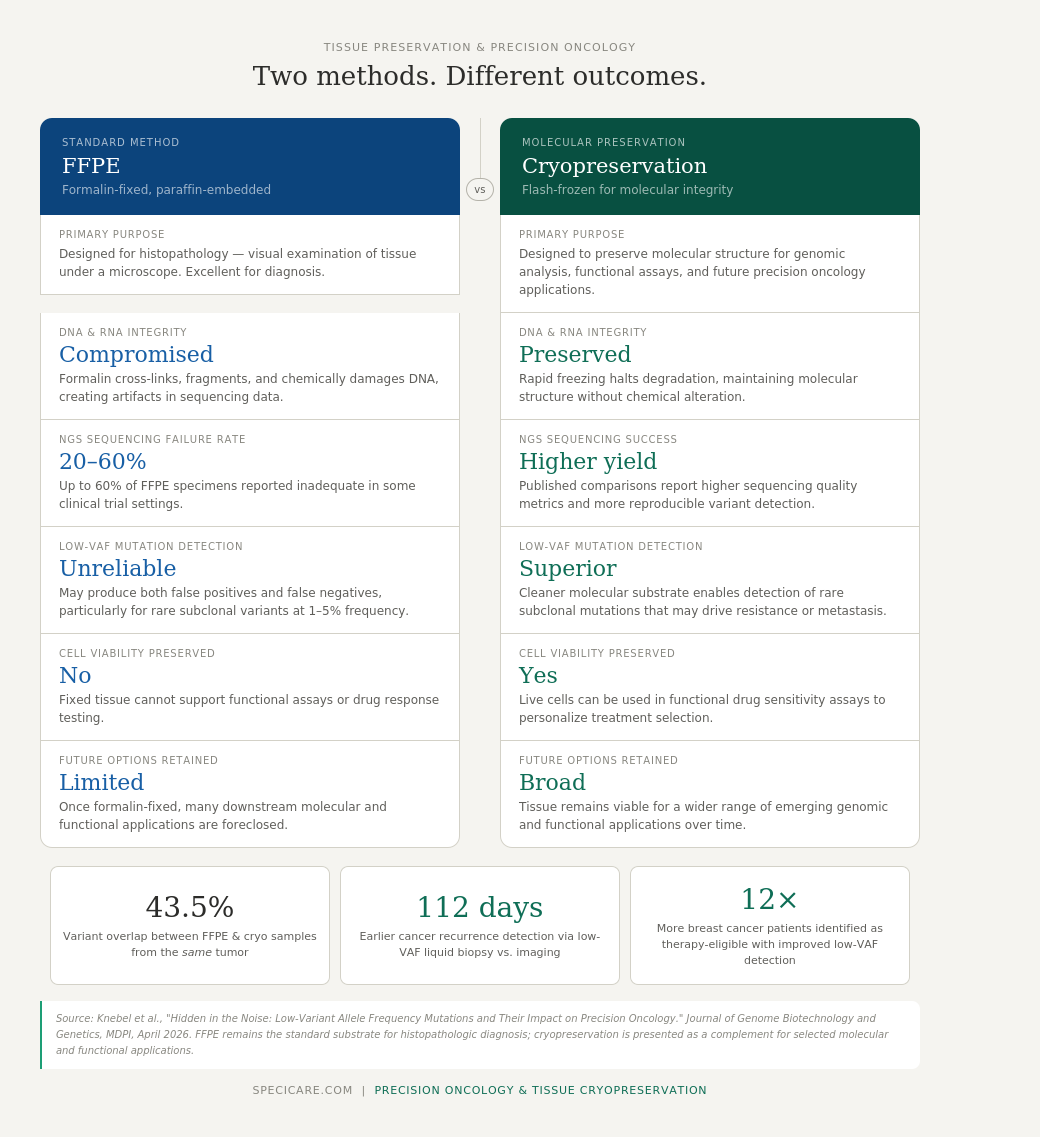
Standard FFPE Preservation vs. Cryopreservation
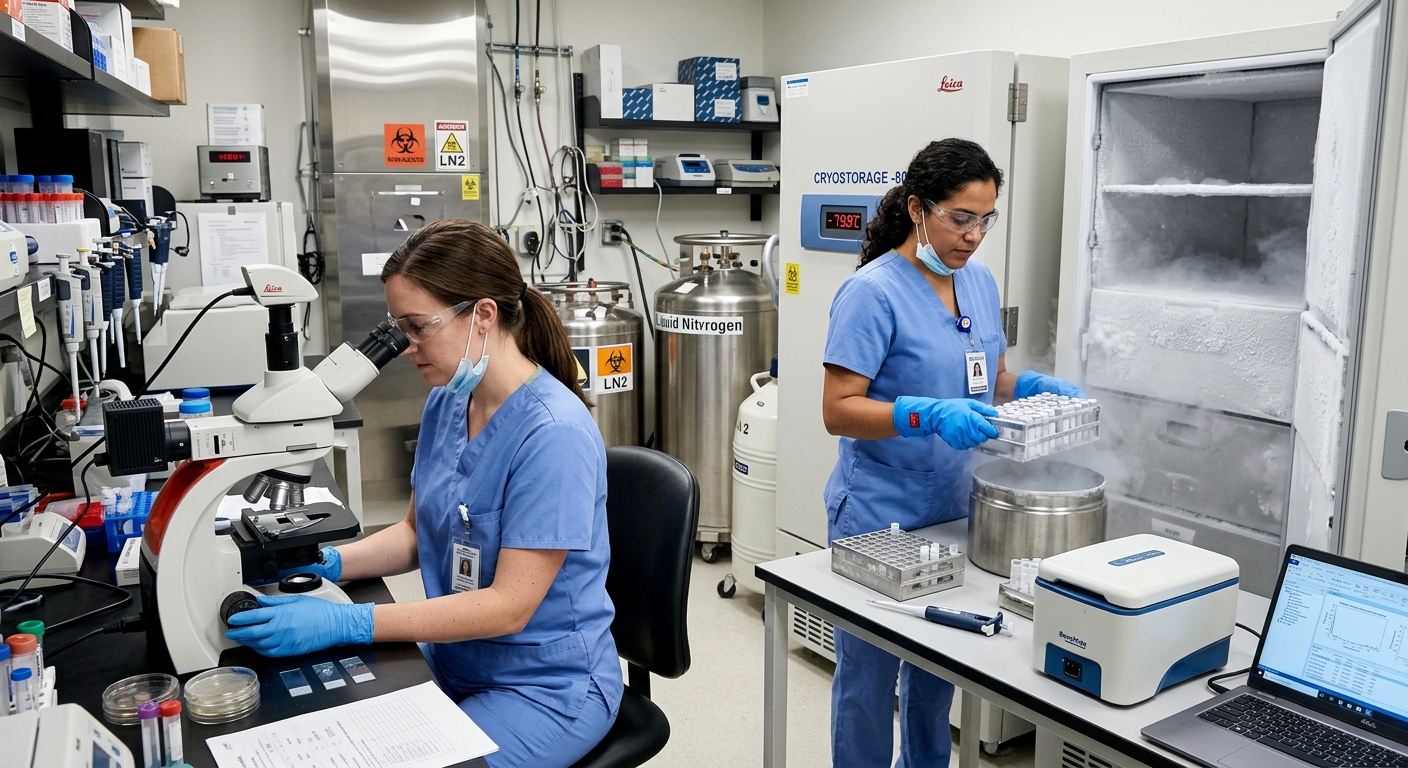
Specicare Tumor Tissue Cryopreservation

Specicare Talk to Your Doctor about Cryopreservation
Tissue Cryopreservation Preserves More Future Options
The way a patient's tumor tissue is preserved after surgery is not a logistical afterthought. It is a meaningful pre-analytic variable that can influence the quality of the genomic information.”
GAINESVILLE, GA, UNITED STATES, April 10, 2026 /EINPresswire.com/ -- When a surgeon removes a cancer tumor, a clock starts ticking. The decisions made in those first hours — specifically, how that tissue is preserved — may influence whether a patient's genomic data is reliable or instead affected by degradation and artifact. A newly published, peer-reviewed study from SpeciCare researchers examines that question using evidence drawn from sequencing technology, molecular biology, and published clinical literature.— Dr. Jared J. Barrott, Chief Science Officer, SpeciCare
The paper, titled "Hidden in the Noise: Low-Variant Allele Frequency Mutations and Their Impact on Precision Oncology," was published in the Journal of Genome Biotechnology and Genetics (MDPI). The corresponding author is Dr. Jared J. Barrott, Chief Science Officer of SpeciCare, alongside co-author Dr. Ken Dixon, SpeciCare's founder and lead surgeon, and a team of researchers from Brigham Young University's Simmons Center for Cancer Research.
"The way a patient's tumor tissue is preserved after surgery is not a logistical afterthought. It is a meaningful pre-analytic variable that can influence the quality of the genomic information that follows throughout that patient's care."
— Dr. Jared J. Barrott, Chief Science Officer, SpeciCare
THE PROBLEM: STANDARD TISSUE PRESERVATION AND ITS GENOMIC LIMITATIONS
For decades, hospitals have relied on formalin-fixed, paraffin-embedded tissue (FFPE) to store tumor tissue after surgery. FFPE was developed for histopathology — the visual examination of tissue under a microscope — and it continues to serve that purpose well. But precision oncology places additional demands on tumor tissue beyond visual assessment. Today, oncologists may also seek genomic data — specific mutations, subclonal populations, resistance markers, and molecular signatures — that can help guide treatment decisions.
FFPE presents well-documented challenges for these purposes. The formalin fixation process can chemically crosslink, fragment, and damage DNA, introducing changes that may affect sequencing data. Next-generation sequencing (NGS) — the backbone of modern genomic testing — has failed to produce usable results in 20 to 40 percent of FFPE samples in some reported series, and in certain clinical trial settings, up to 60 percent of FFPE tumor specimens have been reported as inadequate for intended use.
Specicare's own previously published matched-pair study found that when comparing cryopreserved and FFPE tissue samples from the same patient's tumor, only 43.5 percent of detected genetic variants overlapped between the two preservation methods. The paper discusses the implications of that discordance — including the possibility that FFPE-based sequencing may both miss real variants and generate artifactual ones — while acknowledging that additional research is needed to clarify the full clinical significance of these findings.
WHY THIS MATTERS: THE MUTATIONS THAT HIDE IN THE NOISE
The research centers on a class of genetic changes called low-variant allele frequency (low-VAF) mutations — mutations present in as little as 1 to 5 percent of a patient's tumor cells at a given time. Published research suggests that, in at least some settings, these mutations may contribute to drug resistance, metastasis, and relapse.
Cancer is often composed of multiple subclonal populations, each with somewhat different genetic profiles. Standard sequencing tends to identify dominant mutations in the dominant population. Smaller subclonal populations — present at low frequency today — may become more clinically relevant later under treatment pressure.
The SpeciCare paper reviews published clinical examples in which low-VAF mutations appeared consequential: a metastatic lung cancer patient with an EGFR resistance mutation present at just 3 to 4 percent variant allele frequency who achieved partial remission when that mutation was detected and targeted; breast cancer data in which improved detection methods raised the apparent prevalence of a clinically relevant mutation from approximately 1 percent to more than 12 percent, expanding the pool of patients identified as potentially eligible for targeted therapy; and colorectal cancer data in which low-VAF detection in circulating tumor DNA identified cancer recurrence a median of 112 days earlier than imaging.
"FFPE can introduce both false positives and false negatives and may be particularly challenging when the goal is to resolve low-frequency subclonal mutations that may be relevant to recurrence, resistance, or metastasis."
— Knebel et al., Journal of Genome Biotechnology and Genetics, 2026
THE EVIDENCE FOR CRYOPRESERVATION
In contrast to FFPE, cryopreservation is designed to maintain tumor tissue in a more molecularly intact state. DNA and RNA integrity may be preserved with fewer chemically induced alterations, and published comparisons have reported higher sequencing quality metrics and more reproducible variant detection in some contexts. Cryopreservation may also preserve cell viability, enabling downstream functional assays that assess how a patient's tumor cells respond to potential therapies — an option not available from fixed tissue.
The paper's authors conclude that when accurate detection of rare, clinically meaningful variants is a priority, cryopreserved tissue may provide a more informative substrate for genomic profiling in certain settings. FFPE remains the standard substrate for histopathologic diagnosis, while cryopreservation may preserve additional options for selected downstream molecular and functional applications.
A NOTE TO SURGICAL TEAMS AND CANCER CENTER ADMINISTRATORS
The research raises a practical question for hospitals and cancer centers: what happens to patients' tumor tissue in the hours after resection? If tissue is placed only in formalin, some future molecular applications may be limited. SpeciCare works directly with surgical and pathology teams to explore how cryopreservation can be integrated into existing workflows in a way that preserves future options for patients while respecting the continued central role of standard pathology processes.
ABOUT SPECICARE
SpeciCare is a precision oncology company specializing in cancer tissue cryopreservation. By preserving tumor tissue with attention to molecular integrity, SpeciCare works to help patients and their medical teams retain access to tissue suitable for future genomic and functional analyses. SpeciCare partners with cancer centers, hospitals, and surgical practices to integrate cryopreservation into clinical workflows. Learn more at specicare.com.
ABOUT THE PUBLICATION
"Hidden in the Noise: Low-Variant Allele Frequency Mutations and Their Impact on Precision Oncology" was published April 3, 2026 in the Journal of Genome Biotechnology and Genetics (MDPI, Vol. 1, Issue 1). Authors include Jared J. Barrott, Ph.D. (Chief Science Officer, SpeciCare; Brigham Young University), Ken Dixon, M.D. (Founder, SpeciCare), and colleagues from BYU.
Scott Ford
Specicare
+1 417-230-7082
email us here
Visit us on social media:
LinkedIn
Instagram
Facebook
Legal Disclaimer:
EIN Presswire provides this news content "as is" without warranty of any kind. We do not accept any responsibility or liability for the accuracy, content, images, videos, licenses, completeness, legality, or reliability of the information contained in this article. If you have any complaints or copyright issues related to this article, kindly contact the author above.
